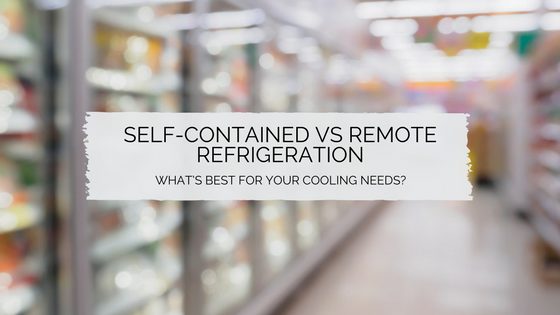
Considering investing in a remote refrigeration system for your business? Here’s everything we think you should know before you do.
Remote refrigeration systems are most often seen in larger establishments – like supermarkets and busy restaurant kitchens, or anywhere else where it isn’t suitable to keep condensers and ventilators due to heat and humidity.
Instead of the condensing unit being built into the commercial fridge, it is usually located elsewhere – usually outside of the building or in a separate room – to control the temperature of your refrigerator.
Like everything, remote refrigeration systems have many benefits, but they aren’t without their drawbacks.
In this post, our commercial refrigeration experts reveal the pros and cons of remote refrigeration, and how it could help your business.

Pro: They cost less to run
Remote refrigeration systems can be much more energy efficient, especially if they’re installed in a cool, outdoor environment.
They can also help reduce your energy bills by reducing the amount of heat your fridge produces that your air conditioner needs to deal with.
Pro: They eliminate noise
Compressors and condensers work hard to maintain the temperature of your commercial refrigerator, and with all this hard work comes lots of buzzing and whirring sounds.
This can become pretty bothersome, especially if you work in a supermarket and have rows upon rows of fridges making a racket. But with a remote refrigeration system, you’ll no longer have to deal with this, as the compressor and condenser will control the temperature of your unit from elsewhere.
You’ll notice a considerable difference in noise levels and be able to work peacefully until it’s time to clock out.
Pro: They help save space inside your refrigerator
Compressors. Condensers. Fans.
They all take up a fair bit of space within your commercial fridge.
But since most of the cooling machinery is located outside of your commercial refrigerator, you’ll have much more space to keep and organise your stock – which could, in turn, allow you to serve more customers and increase your sales.
Con: They cost more to install
Remote refrigerators need to be installed by a professional.
They’ll need to run lines from your commercial kitchen to wherever you want to install the system, which can be a tedious and time-consuming process.
Of course, you’ll pay different prices depending on who you work with, as well as the brand/manufacturer of the unit, but generally, jobs such as these don’t come cheap, so it’s important to make sure you have the room in your budget.
Con: They’re more difficult to maintain
Remote refrigeration systems are much larger than the compressors and condensers found in typical commercial refrigeration units.
Because of this, they can be much more difficult to service, maintain and repair – and you guessed it – as it’s more complicated, it’ll cost you more if things go south.
With cooling equipment located elsewhere, it can also be difficult to tell when things go wrong, and it may take a while for you to discover a breakdown.
This is an easily avoidable issue, though, and you can invest in a remote refrigeration monitoring system – which will alert you (in real-time) when sudden temperature changes occur so that you can investigate and rectify the issue as soon as possible.
Need more info?
Not sure if a remote refrigeration system is right for your business? Want to find out more about the benefits before you take the leap?
We’re here for you.
Our team has over 30 years of experience in the commercial refrigeration industry and would be more than happy to share their expertise.
Give us a call today on 0121 544 0555 or email us at sales@jamrefrigeration.co.uk and we’ll get back to you with more information shortly!
